



Published: Sep 25, 2023
Updated: Aug 2026
The first wave of AI in email marketing was about speed. Subject-line generators. Writing assistants. A button that spat out ten variations of the same headline. Useful, sure. But if you’ve spent real time running an email program, you know writing faster was never the bottleneck.
The bottleneck is deciding. What should we send this week? Who should get it? Which customers are quietly drifting away? Which lifecycle flow is leaking revenue right now? What should we test next? And did we actually learn anything from the last test, or did we just ship it and move on?
That’s the shift happening in AI email marketing in 2026. AI is moving from being a feature inside your email platform toward becoming part of the intelligence that helps run the email program itself. This guide covers what that means in practice: how the technology works, where it helps, where it absolutely doesn’t, and how to evaluate the growing crowd of tools claiming to do all of it.
A working definition: AI email marketing is the use of artificial intelligence to help plan, create, personalize, send, analyze, and optimize email campaigns. Traditional automation follows rules you define in advance. More advanced AI systems learn from customer and campaign data, recommend what to do next, and improve those recommendations over time.
What Is AI Email Marketing?
A few years ago, “AI in email” meant one thing: send-time optimization, maybe a subject-line score. Today the surface area is much wider. AI now shows up across campaign strategy, audience segmentation, subject lines, body copy, design, product recommendations, send timing, lifecycle flows, testing, reporting, optimization, and even deliverability decisions.
That breadth creates a problem for anyone evaluating tools: the label “AI email marketing” gets applied to wildly different things. A platform that added a GPT-powered writing box to its campaign editor and a platform designed from the ground up around intelligence both get to call themselves AI email platforms. They are not the same product, and they don’t produce the same results.
The distinction that matters is architectural. Bolting AI writing features onto a traditional platform makes individual tasks faster. Designing a platform around intelligence from the beginning changes what the platform can actually do for you, because the AI has access to your business context, not just the sentence you’re currently writing.
We’ll come back to this distinction throughout the guide, because it’s the single most useful lens for cutting through the marketing noise.
How Does AI Email Marketing Work?
Start with how email marketing has always worked, because the workflow hasn’t changed much in twenty years:
Campaign → audience → content → design → schedule → test → send → analyze
Every step in that chain is driven by the marketer. You decide the campaign exists. You pick the audience. You write the content, build the design, choose the send time, set up the test. The software executes what you tell it to do: faithfully, quickly, and with zero opinion about whether any of it was the right call.
AI changes the workflow by bringing context into it. Instead of waiting for instructions, an intelligent system can analyze customer behavior, purchase history, product data, previous campaign performance, engagement patterns, lifecycle stage, brand voice, timing, and how past offers performed. From that context, a different loop emerges:
Learn → identify opportunity → recommend → create → approve → send → learn again
Notice two things about that loop. First, “approve” is still in there: a human reviews before anything goes out. Second, and more important, it ends with learn again. Every campaign becomes input for the next decision. That last step is where the compounding happens.
A system that learns from each send gets meaningfully better over months, while a system that starts every campaign from a blank editor stays exactly as smart as it was on day one. I’ve watched teams run hundreds of campaigns a year and retain almost none of the learning, because the learning lived in someone’s head, usually someone who eventually left.
Moving that memory into the system is one of the quietly important things AI does for an email program.
The Three Levels of AI in Email Marketing
Not all AI does the same job. It helps to separate what’s actually running under the hood into three layers, because vendors tend to blur them together.
Predictive AI
Predictive AI answers one question: what is likely to happen?
This is the oldest layer. Purchase likelihood, churn risk, optimal send time, product affinity, engagement probability, customer lifetime value, offer response likelihood: models for all of these have existed for years, and some ESPs have shipped versions of them for a decade.
Here’s the honest problem with predictive AI as most teams have experienced it: predictions that nobody acts on are trivia. I’ve seen plenty of accounts with a churn-risk score sitting on every customer profile and not a single campaign, flow, or suppression rule that uses it. The score existed; the decision didn’t.
Predictive AI becomes valuable at the exact moment a prediction changes what gets sent, to whom, or when. Until then it’s a dashboard widget.
Generative AI
Generative AI answers a different question: what should we create?
This is the layer everyone met in 2023: subject lines, preview text, headlines, body copy, calls to action, product descriptions, campaign concepts, images, layout ideas, testing variations. It’s the most visible layer and, frankly, the easiest one to ship, which is why every platform now has it.
Generation is useful. It is also not the same thing as intelligent email marketing. A beautifully written email sent to the wrong audience at the wrong time is still the wrong email. Generative AI on its own solves the production problem; it doesn’t touch the judgment problem.
If your emails already convert poorly, being able to produce three times as many of them is not the upgrade you were hoping for.
System-Level Intelligence
The third layer is where things get interesting, and it’s the one worth paying attention to in 2026. It moves past “what can AI predict?” and “what can AI create?” to the question operators actually wrestle with every Monday morning:
What should the email program do next?
Answering that requires combining signals the first two layers handle in isolation: customer behavior, product data, engagement, previous campaign performance, gaps in the lifecycle, revenue opportunities, brand rules, and deliverability considerations, all weighed together, the way an experienced email lead would weigh them.
This is the layer Mailberry was built around. At Mailberry, that intelligence layer is called The Email Brain™. The Email Brain™ learns the business (products, audience, brand, email strategy, and performance history) and uses that context to help surface what should be sent next, then helps build the campaigns and flows to act on it.
It doesn’t replace the marketer’s judgment; it replaces the blank calendar the marketer used to stare at.
AI Email Marketing vs Traditional Email Marketing
The cleanest way to see the differences is side by side. Note there are three columns here, not two; the middle one is where most platforms currently live.
| Traditional Email Marketing | AI-Assisted Email Marketing | AI-Native Email Marketing | |
|---|---|---|---|
| Who spots the campaign opportunity | The marketer | The marketer | The system surfaces opportunities; the marketer decides |
| Who chooses the audience | The marketer builds rules manually | The marketer, with predictive scores available | AI recommends segments from behavior; marketer approves |
| Content creation | Written from scratch | AI drafts on request, from a prompt | AI drafts from business context, brand, and past performance |
| Campaign design | Manual, template by template | Manual with AI-generated pieces | AI assembles a draft campaign; marketer refines |
| Timing | Fixed schedules | Send-time optimization per campaign | Timing informed by engagement patterns across the program |
| Analysis | Dashboards report what happened | Dashboards plus AI summaries | System interprets results and feeds them into the next recommendation |
| Learning from previous campaigns | Lives in the marketer’s memory | Mostly still in the marketer’s memory | Retained by the system and compounds over time |
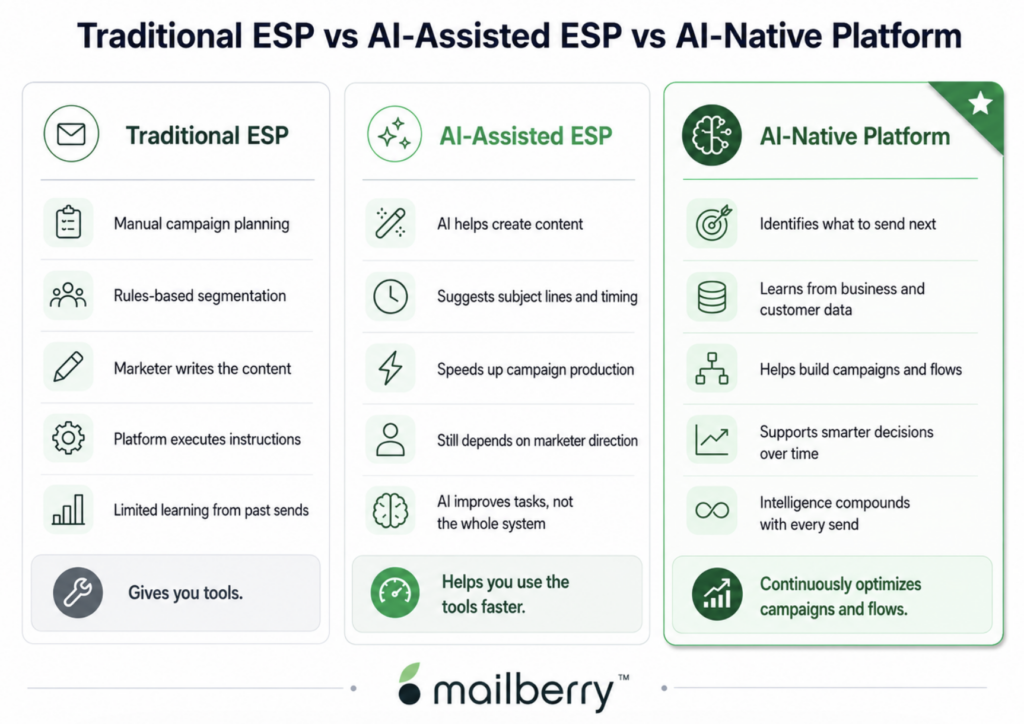
The core distinction running through every row: traditional automation executes rules the marketer already created. AI, done properly, increasingly helps determine which campaign, audience, rule, or action should exist in the first place. That’s not a feature difference. It’s a difference in who’s doing the thinking.
See What AI-Native Email Marketing Looks Like
The Email Brain™ inside Mailberry learns your business, identifies what to send next, and helps build your campaigns and flows.
What Can AI Automate in Email Marketing?
Here’s where the theory turns into a job description. These are the pieces of the email workload AI can actually take on today, with notes on where the ceiling is.
Campaign Planning
The hardest question in email marketing has never been “how do I build this?” It’s “what should we send?” Ask anyone who’s owned a send calendar: the blank week is scarier than the busy one.
Traditional platforms give you calendars, editors, and templates, and then leave that question entirely to you. AI changes the input. By drawing on business context, customer behavior, product data, seasonality, and what has and hasn’t worked before, an intelligent system can suggest campaign opportunities instead of waiting for you to invent them.
A structured approach here, what we think of as an AI email marketing recipe system, turns campaign planning from a weekly brainstorm into a review of ranked options.
Email Copywriting
Subject lines, preview text, headlines, body copy, product messaging, CTAs: generative AI handles all of it competently now. The interesting question isn’t whether AI can write an email. It’s whether the AI writing your email knows anything about you.
Generic AI can produce grammatically flawless copy for a brand it has never heard of, aimed at an audience it can’t see, for a campaign objective it’s guessing at.
Contextual AI writes with your brand voice, your products, your audience, your campaign objective, and your previous performance in view. The difference matters because email performance depends on relevance and context, not simply whether the copy reads well. If you want a quick feel for AI-generated copy, an email subject line generator is the lowest-friction place to start. Just know that subject lines are the shallow end of the pool.
Segmentation
Rules-based segmentation is what most of us grew up on: “purchased in last 90 days AND opened in last 30.” It works, but it only captures the patterns you already thought to look for.
AI-assisted segmentation reads the behavior directly (purchase frequency, product affinity, recency, engagement, customer value, lifecycle stage, repurchase probability, churn risk) and finds cohorts a human wouldn’t have defined.
The practical upside isn’t exotic micro-segments. It’s that your “engaged customers” segment stops being a guess frozen in time and starts tracking what engagement actually looks like in your list this quarter.
Personalization
Let’s retire the idea that personalization means “Hi {{first_name}}.” Nobody has been fooled by that since roughly 2009.
Real personalization is deciding what each person receives: which products, which offers, what timing, what message angle, how often, and where they are in their lifecycle. AI makes it possible to personalize those decisions across an audience at a scale that would be extremely difficult to manage manually.
But keep the objective straight: the goal is not to make every email different. It’s to make every email more relevant. Difference is easy to automate and worthless on its own. Relevance is the thing that moves numbers.
Lifecycle Marketing
Welcome, browse abandonment, cart abandonment, post-purchase, cross-sell, replenishment, VIP, win-back, re-engagement. The standard lifecycle map has been stable for years, and almost nobody covers all of it. In most accounts I’ve looked at, there’s a welcome series, a cart abandonment flow, and a graveyard of “we should really set that up” conversations.
This is a place AI earns its keep in an unglamorous way: analyzing which lifecycle programs are missing or underperforming and telling you which one deserves attention first. Prioritization, not magic.
A merchant with strong first-purchase volume and weak repeat rates doesn’t need a better welcome series. They need a post-purchase and replenishment program, and an intelligent system can spot that gap from the data.
Campaign Creation
When AI has access to brand information, product data, the campaign objective, the audience, previous campaigns, and any creative direction you give it, it can produce a full draft: strategy, subject line, copy, layout, product selection, CTA, and design direction, assembled together rather than generated piece by piece.
That shifts the marketer’s job. Less assembling, more editing. You move from building every campaign by hand to reviewing, refining, and approving, which, not coincidentally, is the part of the job that actually requires your judgment.
Testing and Optimization
Traditional A/B testing asks narrow questions and forgets the answers. Subject line A beat subject line B by 4%. Great, we shipped it, and three months later nobody remembers why or whether the pattern held.
AI’s contribution here is pattern recognition across the whole program: which campaign themes work, which audiences respond to discounts versus educational content, which subject structures consistently outperform, which offers correlate with repeat purchase, which flows are losing engagement month over month.
The point isn’t running more tests. It’s extracting more learning per test, and keeping that learning somewhere it survives staff turnover.
Reporting and Analysis
Every dashboard ever built tells you what happened. Open rate, click rate, revenue per send. Fine. The questions that pay the bills are why did it happen? and what should we do next?
That’s where AI-driven reporting is heading: “this segment is declining,” “this flow has been underperforming since March,” “these 400 customers look ready for a cross-sell,” “this campaign format is running well above your baseline, so do more of it.” Reporting that ends in a decision, not a chart. If your reporting stack makes you do all the interpretation yourself, you don’t have analysis. You have arithmetic.
AI-Assisted vs AI-Native Email Marketing
This distinction has come up several times, so let’s pin it down properly, because it’s the most common source of confusion when teams evaluate platforms.
An AI-assisted platform is a traditional ESP with AI features attached to individual tasks: AI writing, subject-line suggestions, send-time recommendations, content generation. Each feature makes one step faster. The workflow, and the thinking, still belongs entirely to you. Every feature is a separate tool you pick up, use, and put down.
An AI-native platform builds intelligence into the operating model itself. The AI participates in understanding the brand, the products, the audiences, and the growth opportunities; in creating campaigns and flows; and in learning from performance. Context flows between all of it, because it was designed to.
The shortest version I can give you:
AI-assisted email helps the marketer operate the platform. AI-native email helps operate the email program.
That one sentence is worth more than most feature comparison pages. An AI-native email marketing platform isn’t defined by having more AI features than the next tool. It’s defined by whether the intelligence sits at the center of the system or gets sprinkled on top.
How to Build an AI Email Marketing Strategy
Adopting AI without a plan produces the same result as adopting any tool without a plan: a shelf of features and no change in outcomes. Here’s the sequence that works, condensed to five steps. (For the long-form version, see our full AI email marketing strategy guide.)
Step 1: Define the Outcome
Start with the business result, not the AI feature. First purchase, repeat purchase, retention, average order value, lifecycle coverage, campaign production speed, engagement, deliverability: pick the one that matters most right now. “We want to use AI” is not an outcome. “We want repeat purchase rate up” is, and it immediately tells you which AI capabilities are relevant and which are decoration.
Step 2: Connect Useful Context
AI recommendations are only as good as what the system can see. Useful context includes customer data, your product catalog, purchase history, website behavior, brand guidelines, previous campaigns, and email performance history. This step is unglamorous and it’s the one teams most often skip.
A system with rich context makes recommendations that feel like they came from someone who knows your business. A system without it makes recommendations that feel like they came from a template, because effectively they did.
Step 3: Find the Highest-Value Use Case
Do not automate everything at once. Match the AI to the problem you actually have:
“We don’t send campaigns consistently.” → Campaign ideation and creation. The blockage is deciding and producing; solve that.
“We have customers but weak repeat purchase.” → Lifecycle analysis, segmentation, and win-back/cross-sell programs. The blockage is missed opportunities in your existing base.
“Our team spends too much time operating the ESP.” → Campaign and flow creation. The blockage is production overhead eating strategy time.
One use case, done well, funds the credibility for the next one.
Step 4: Keep Human Approval Where It Matters
Decide up front what always gets human review: offers, brand claims, sensitive communications, major promotions, new segmentation logic, high-risk sends. Write it down. The goal of AI in email is to eliminate unnecessary work, not to eliminate judgment. Teams that skip this step don’t discover the gap until an email they wouldn’t have approved is already in inboxes.
Step 5: Create a Learning Loop
Learn → act → measure → learn again.
This is the step that separates teams that get compounding value from teams that get a one-time productivity bump. If insights from each campaign feed the next recommendation, the system gets smarter every month you use it. That compounding is the single biggest structural advantage AI systems have over both manual processes and static automation, but only if the loop actually closes.
AI Email Marketing for Ecommerce
Ecommerce is where AI email marketing earns its clearest wins, for a simple reason: ecommerce generates exactly the kind of data AI feeds on. Products viewed, products purchased, purchase frequency, cart behavior, order value, categories purchased, time since last order, discount responsiveness, engagement history. Every customer writes their own brief.
A concrete example. Take two people who interacted with the same pair of running shoes this month. One bought them. The other viewed them four times and never purchased. Same product, completely different next email.
The buyer should hear about socks, insoles, a training plan, or a replenishment nudge in four months. The lurker needs a reason to get off the fence: social proof, a sizing guide, maybe an offer if their profile suggests they’re price-sensitive.
Traditional automation can execute both of those journeys once you’ve built them. What it can’t do is tell you which journeys to build, which of your customers currently fall into patterns like these, and which message, product, timing, and audience combination deserves priority this week. That prioritization layer is what AI adds.
In ecommerce, where a mid-size store can have thousands of customers in dozens of behavioral states at once, it’s the difference between covering the obvious flows and actually working your list. (If you’re building up your ecommerce program from the ground, our free ecommerce email marketing course covers the foundations that AI builds on.)
AI Email Marketing for Shopify
Shopify brands have a structural advantage here that’s easy to overlook: the store already contains most of the context an intelligent email system needs. Catalog, purchase behavior, product categories, order history, lifecycle activity, and once email is running, performance data on top of it.
That matters because of what it eliminates. Instead of asking a merchant to explain their business from scratch by filling out brand questionnaires, uploading CSVs, and re-describing their bestsellers to a chatbot, an intelligent email platform can start learning from the store itself, from day one.
This is exactly how Mailberry approaches it. Inside Mailberry, The Email Brain™ uses business and email context to help surface opportunities and determine which campaigns or flows should be built next.
Connect the store, and the system starts from your actual products, customers, and history rather than from a blank campaign editor and a blinking cursor. Anyone who has onboarded onto a traditional ESP knows how different that starting point feels.
Stop Starting Every Campaign From Scratch
Connect your business to Mailberry and let The Email Brain™ learn your brand, products, audience, and email performance. See what’s worth sending next, then build it.
AI Email Marketing and Deliverability
Time for the section every AI email article should include and most skip. Let’s be blunt:
AI cannot fix bad email fundamentals.
Most serious email deliverability problems I’ve helped diagnose eventually trace back to a familiar set of fundamentals: permission problems, missing or broken authentication, damaged sending reputation, high complaint rates, weak engagement, poor audience quality, erratic sending behavior, or plain irrelevance.
No model fixes those. If you bought a list, no subject line, human or AI, is getting you into the inbox. If your SPF, DKIM, and DMARC aren’t in order, you have a plumbing problem, not a content problem.
Where AI legitimately helps deliverability is on the discipline side, because deliverability is mostly discipline applied consistently:
It can identify disengaged audiences before they hurt you, spot engagement decay in segments that used to perform, surface suppression opportunities you’d otherwise catch six months late, flag campaigns generating unusually negative signals, analyze whether your frequency is burning out parts of your list, and identify the high-engagement cohorts that protect your sender reputation when you’re warming up or recovering.
Notice the pattern: all of that is AI making good sending practices easier to execute. None of it is AI replacing them. Any tool that implies its AI can route around reputation, or that you can send more aggressively because the AI will handle it, is selling you the fastest available route to the spam folder.
What AI Should Not Automate Blindly
The goal is not “automate everything.” The goal is to automate the right things while improving the quality of decisions. Some categories deserve a permanent human in the loop:
Brand judgment
AI can imitate a voice; it can’t own one. Whether a joke lands, whether a campaign fits the moment, whether the tone is right for a customer who just had a bad experience: those calls stay with people who carry responsibility for the brand.
Sensitive communications
Apologies, service failures, incident notices, anything touching health, money, or a customer’s bad day. These emails carry disproportionate risk and get read with disproportionate attention. Draft with AI if you like; a human signs off, every time.
Offers and economics
AI should not invent pricing, discounts, guarantees, or financial claims. A hallucinated “60% off sitewide” isn’t a typo. It’s a liability with your logo on it. Offer terms come from the business, get approved by the business, and only then flow into campaigns.
Audience permission
AI does not replace consent or responsible list management. No intelligence layer converts a purchased list into an opted-in one, and no engagement model launders a subscriber who never asked to hear from you.
Strategy
AI can surface opportunities, often ones you’d have missed. But which products to push, which customer relationships to invest in, what the brand should stand for this year: those are business priorities, and they’re set by humans.
The framing worth keeping: human judgment + machine intelligence, not human vs AI. Teams that treat it as a partnership get leverage. Teams that treat it as a replacement get incidents.
How to Choose an AI Email Marketing Platform
Every platform now claims AI. Here are the five questions that actually separate them. Use these in demos and watch which ones make the salesperson change the subject.
Does the AI understand my business?
Can it learn your products, brand, audience, customer behavior, and previous performance? Or does every interaction start from another blank prompt? A system that knows nothing about you can only give advice that applies to everyone, which is another way of saying advice that applies to no one.
Does it generate content, or help make decisions?
Content generation is table stakes in 2026. The harder question is whether the system helps determine what to send, who to send it to, when, which lifecycle opportunity you’re missing, and what should be optimized next. Ask the vendor to show you a recommendation, not a writing sample.
Does it learn over time?
If every campaign starts from zero, you’re looking at an isolated AI assistant, not an intelligence layer. Ask specifically: what does this system know about my program after six months of use that it didn’t know in week one? If the answer is vague, the answer is nothing.
Can it execute?
Recommendations that stop at recommendations just add reading to your day. Can the system turn its suggestions into actual campaigns, flows, segments, content, designs, and tests you can review and launch? Insight without execution is a newsletter about your newsletter.
Does it fit the business model?
For ecommerce specifically: does it integrate with your store, understand product data, support the full lifecycle, read customer behavior, segment on it, and report on revenue rather than just opens? An AI platform built for B2B newsletters will be smart about the wrong things.
The grounded takeaway: the best AI platform is not the one with the most AI features. It’s the one with the right context to solve your problem. Context beats features, every time.
The Future of AI Email Marketing
Skip the crystal ball; the trajectory is already visible in the questions marketers ask their tools. Watch how they’ve changed.
Generation
“Write my subject line.” “Write my email.” “Create an image.” This era is here and largely commoditized; every platform does some version of it.
Intelligence
“What should I send?” “Who should receive it?” “What opportunity am I missing?” This is where the market is right now: systems moving from producing assets to informing decisions.
Execution
“Build it.” “Test it.” “Launch it.” “Learn from it.” The emerging edge: recommendations that turn directly into reviewable campaigns and flows, with each result feeding the next recommendation.
The broader arc is manual → automated → intelligent → increasingly autonomous. Note the word increasingly. Fully autonomous email marketing has not arrived, whatever the launch-day demos imply, and treating current systems as though it has is how brands end up apologizing in their next send. Marketers still set objectives. Strategy still matters. Brands still need human judgment on everything customers actually feel.
What changes is where humans spend their hours. The repetitive execution layer (assembling campaigns, building segments, monitoring flows, compiling reports) is what steadily moves to intelligent systems. AI email marketing is evolving from a writing assistant you occasionally consult into part of the infrastructure that runs the program, with you directing it.
Where Mailberry Fits
Mailberry was built around exactly this shift from tools toward intelligence.
Rather than starting with a traditional ESP and layering isolated AI features onto it, Mailberry is designed around The Email Brain™: an intelligence layer that learns your business (products, brand, audience, strategy, and performance), then helps identify opportunities and provides the context used to build campaigns and flows. You review, refine, and approve; the system handles the heavy assembly and remembers what it learns.
The core promise is simple:
Less time operating email software. More intelligence directing the email program.
That’s what Mailberry means by AI-native email marketing.

You Don’t Need Another Email Tool. You Need One That Thinks With You.
The Email Brain™ learns your business, spots growth opportunities, and helps turn those opportunities into campaigns and flows.
No blank canvas. No guessing what to send next. Just a smarter way to run email marketing.
No credit card required • 14-day free trial • Shopify integration
Frequently Asked Questions
What is AI email marketing?
AI email marketing is the use of artificial intelligence to help plan, create, personalize, send, analyze, and optimize email campaigns. Unlike rule-based automation, AI systems can learn from customer and campaign data, recommend what to do next, and improve their decisions over time.
How is AI used in email marketing?
Common uses include campaign planning, audience segmentation, subject lines and copy, product recommendations, send-time optimization, lifecycle flow analysis, testing, and reporting. The most advanced use is system-level: analyzing business context to recommend which campaigns and flows should exist in the first place.
Can AI automate email marketing?
AI can automate large parts of it, including campaign creation, segmentation, personalization, testing, and analysis. It should not automate offers, pricing, sensitive communications, or brand judgment without human review. The practical model today is AI handling execution while humans approve and direct.
What is the difference between AI email marketing and email automation?
Automation executes rules you’ve already defined: “if cart abandoned, send this email in one hour.” AI helps determine what the rules, campaigns, and audiences should be, and improves those decisions by learning from results. Automation follows instructions; AI helps write them.
What is an AI-native email marketing platform?
A platform designed around intelligence from the start, rather than a traditional ESP with AI features bolted on. AI-assisted platforms help you operate the software; an AI-native platform helps operate the email program itself, learning the business, surfacing opportunities, and helping build what comes next.
Can AI improve email personalization?
Yes, well beyond inserting a first name. AI can personalize product selection, offers, timing, message angle, frequency, and lifecycle communication for each recipient. The goal is relevance, matching what each person receives to their actual behavior, not making every email different for its own sake.
Is AI useful for ecommerce email marketing?
Especially so. Ecommerce generates the behavioral data AI needs (views, purchases, cart activity, order values, category preferences), so the system can determine which message, product, and timing deserves priority for each customer instead of running the same generic flows for everyone.
How can Shopify brands use AI for email marketing?
By connecting store data (catalog, orders, customer behavior, lifecycle activity), an AI email platform can learn the business directly from Shopify instead of starting from a blank slate. Inside Mailberry, The Email Brain™ uses that context to surface what’s worth sending next and help build it.
Will AI replace email marketers?
No, but it’s changing the job. The assembly work of building campaigns, segments, and reports by hand increasingly moves to AI. Strategy, brand judgment, offer decisions, and approval stay human. Marketers who direct intelligent systems will outproduce marketers who operate software manually.
What should I look for in an AI email marketing tool?
Five things: whether the AI can learn your business, whether it helps make decisions rather than just generating content, whether it improves over time, whether its recommendations turn into executable campaigns and flows, and whether it fits your business model. Context matters more than feature count.

 in Los Angeles