


Over the last year, “AI analyst” has become one of the most overused phrases in marketing technology.
Nearly every platform now claims to have one.
The promise is attractive:
An autonomous system that analyzes your data, spots opportunities, and tells you exactly what to do.
But in most cases, what’s presented as an “AI analyst” is little more than a thin layer of prompt engineering wrapped around surface-level metrics. It can summarize performance. It can rephrase trends. It can generate generic suggestions.
What it rarely does is embed real strategic thinking into the product.
At Mailberry, we’re not building a single AI analyst agent feature.
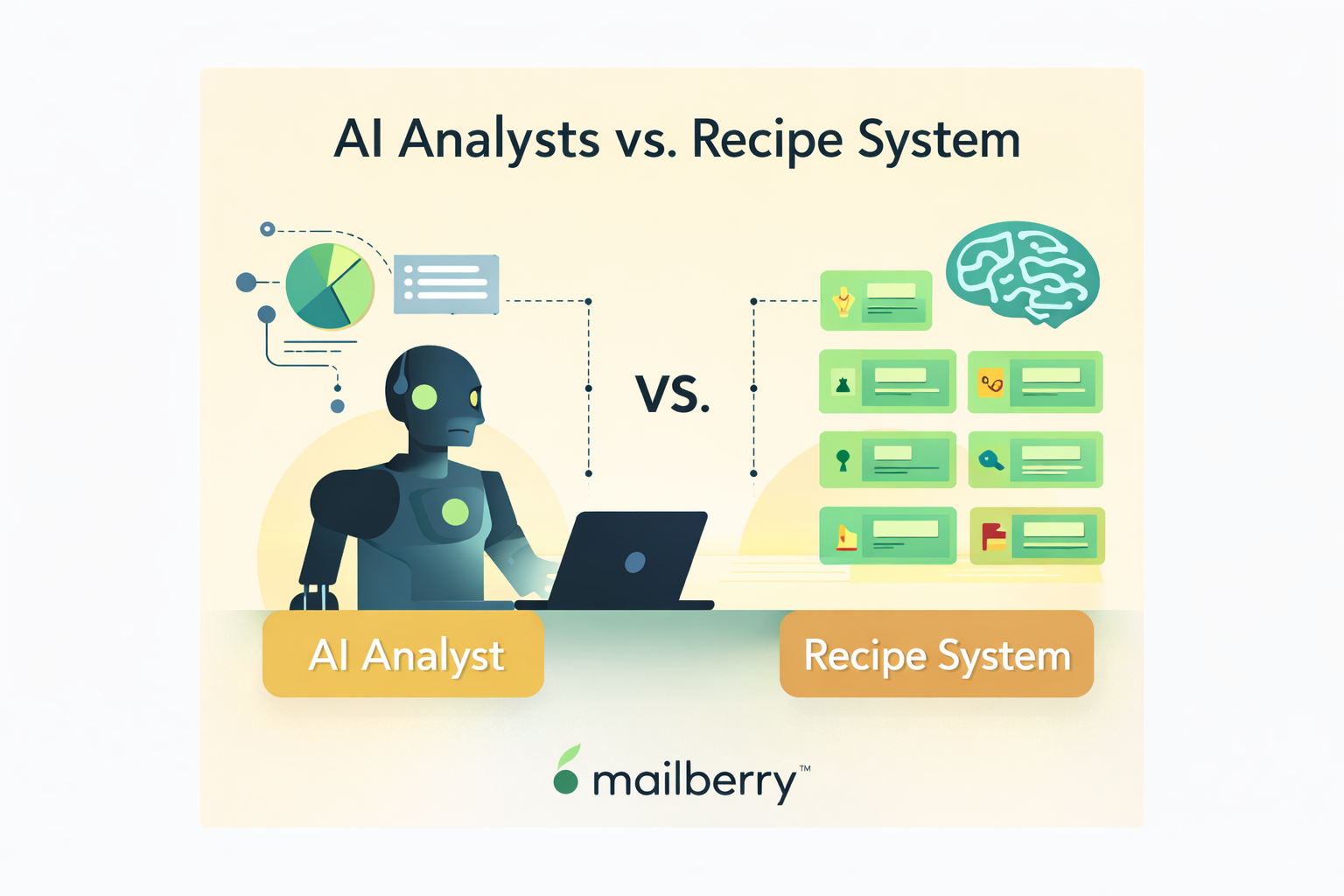
We’re building something fundamentally different: a compounding recipe system.
The Analyst Is Not a Feature. It’s a System.
Internally, we don’t think of the analyst as a standalone capability.
We think of it as the “brain” behind a growing library of recipes.
A recipe is not a suggestion.
It is not a dashboard insight.
It is not a vague recommendation.
A recipe is a concrete, reusable strategic play that can be executed against real data and brand info.
Every recipe includes:
- A defined trigger condition
- A clear baseline for comparison
- A diagnostic explanation
- Specific next steps
- The ability to re-run or schedule the logic over time
This structure matters.
It forces discipline. It forces clarity. It forces us to define what “normal” actually means for a brand before we claim something is “wrong.”
And every time we build a new recipe, we are required to improve the underlying intelligence:
- Better data modeling
- Better contextual prompts
- Better decision frameworks
- Better definitions of thresholds and risk
The analyst becomes smarter not because we market it that way, but because the recipes become sharper and more reliable.
Reliability Over Novelty
AI can usually produce outputs that are 80% good.
That’s enough to impress in a demo.
It is not enough to build trust.
At Mailberry, we built what we call Brain Trust — an expert-tuned prompt library designed to move outputs from “mostly correct” to “operationally reliable.”
Brain Trust does not expand what AI is capable of in theory.
It improves consistency.
It embeds real-world email expertise into the system so that recommendations are not just plausible, but dependable enough to act on.
In email marketing, that final layer of reliability is not cosmetic. It affects revenue, sender reputation, and long-term performance.
We optimize for that layer.
The Three Pillars of Our Recipe System
Email performance is not a single-variable problem. It sits at the intersection of creative, strategy, and deliverability.
Our recipes are structured around those three pillars.
1. Creative Recipes
These are structured plays that improve how emails are conceptualized and executed.
Examples include:
- Generating new email campaign angles based on performance history
- Creating subject line and preview text variants aligned with engagement decay patterns
- Suggesting visual treatments based on past click-through behavior
- Reframing offers to match segment-specific intent
The key difference is that these are not isolated outputs. They are repeatable plays that evolve as more examples are gathered.
2. Strategy Recipes
Strategy is where most email programs break down.
Segmentation becomes bloated. Lifecycle logic drifts. Frequency increases without guardrails.
Strategy recipes include:
- Segment decay detection
- Audience pruning recommendations
- Lifecycle gap analysis
- Re-engagement sequencing
- Frequency recalibration
Instead of telling you “engagement is down,” the system identifies where structural issues exist and surfaces a defined play to correct them.
Strategy becomes executable, not theoretical.
3. Email Deliverability Recipes
This is where generic AI systems typically fail.
Deliverability cannot be handled with vague summaries.
It requires mailbox-level analysis, baselines, and disciplined diagnostics.
At Mailberry, we define hard performance baselines per mailbox provider:
- Gmail
- Outlook
- Yahoo
- Others
If Gmail performance drops 10–15% below your established norm, that can trigger a deliverability recipe card.
That card:
- Explains what changed
- Anchors performance to your historical baseline
- Identifies probable causes
- Suggests specific next steps
- Can be scheduled to re-evaluate weekly or monthly
This is not reactive panic. It is structured monitoring.
And importantly, it is contextualized to your account, not industry averages.
The Marketer Stays in Control
One of our core principles is simple:
AI should elevate the marketer, not override them.
Mailberry does not blindly auto-run campaigns. We surface structured alerts and recommendations.
You decide when to execute.
This preserves judgment, protects brand nuance, and prevents automation from outrunning strategy.
The goal is not autonomy at all costs. The goal is intelligent leverage.
Why We Build Recipes Using Live Accounts
We are not training this system on pristine demo data.
We are building recipes using live accounts. Your live account.
Real accounts introduce real constraints:
- Messy segmentation
- Inconsistent engagement
- Domain-level reputation fluctuations
- Provider-specific filtering behavior
These constraints are not inconveniences. They are necessary friction.
Every high-quality recipe requires depth. Typically 10–30 real-world examples are needed before the pattern is stable enough to trust.
Without that foundation, AI advice becomes noise disguised as intelligence.
By building against live systems, the recipes become grounded in reality.
This approach is slower at first. But it compounds.
The Long-Term Vision
Over time, your specific recipes form the foundation of a higher-level agent.
You will be able to ask:
“What can I do to improve my email program this month?”
And instead of receiving generic best practices, you’ll receive a response grounded in:
- Your engagement patterns
- Your mailbox-level trends
- Your audience health
- Your sending cadence
- Our accumulated strategic email playbook
Not theoretical advice. Contextual execution.
The Long Game Is Compounding Strategy
We are not chasing the label of “AI analyst.”
We are building a compounding system that captures expert email strategy across creative, segmentation, and deliverability.
Each recipe strengthens the next.
Each account improves the intelligence layer.
Each execution feeds the system.
Over time, this creates something far more durable than a feature:
A structured, repeatable playbook that any marketer can run on demand; powered by real data, disciplined thresholds, and embedded expertise.
That is the system we believe modern email marketing requires.
And that is what we are building at Mailberry.

 in Los Angeles