


Published September 25, 2023
Updated August 2026
Email marketing does not need to be complicated.
That is worth saying up front, because most small business owners assume the opposite. They picture sophisticated automation maps, perfectly timed sends, elaborate segmentation strategies, and an endless queue of decisions about what to write and when. So email either never gets started, or it gets started and quickly abandoned.
After more than 15 years working in email marketing and deliverability, I can tell you the businesses that win with email are rarely the ones running the most complex programs. They are the ones running a consistent program. The mechanics are simpler than they look:
- Build an audience of people who gave you permission to contact them.
- Welcome them properly.
- Give them something valuable.
- Keep the relationship alive.
- Give them reasons to come back.
- Do it consistently.
That is the whole game. Everything else in this guide is detail in service of those six lines.
The mindset shift that makes it work is treating email as an ongoing customer relationship rather than a series of disconnected promotions. This guide walks through why that matters, the mistakes that derail most small businesses, a simple framework for thinking about your program, and seven practical steps to build one that actually runs.
Why Email Marketing Matters for Small Businesses
Most small-business marketing is obsessed with acquisition. More ads. More leads. More followers. More new customers. The entire budget and all the attention point at strangers.
Meanwhile, there is a group of people who have already purchased from you, visited your store, subscribed to your list, hired your firm, or asked about your services. These people crossed a trust barrier that strangers have not. They know who you are. They raised their hand.
And in many small businesses, nobody talks to them again until it is time to sell something.
Email is the direct channel to that group. Unlike paid and social channels, email gives you a direct way to reach an audience that has explicitly chosen to hear from your business. You are landing in the inbox of someone who asked to hear from you.
What can you actually do with that channel? More than sell:
- Educate customers on getting more value from what they bought.
- Recommend products or services that fit what they already chose.
- Remind people to come back: for a reservation, a reorder, a checkup, a renewal.
- Highlight useful information they would not have found on their own.
- Support repeat purchases, rebookings, and renewals.
- Build loyalty by being helpful between transactions.
- Stay top-of-mind so that when the need arises, you are the business they think of first.
Here is the conceptual shift that separates good small-business email programs from forgettable ones. Most businesses ask:
“How do I use email to generate another sale?”
The better question is:
“How do I use email to build a customer relationship that creates more opportunities for sales over time?”
The first question produces a list that gets blasted with promotions until it stops responding. The second produces an audience that opens your emails, buys again, refers friends, and sticks around for years. The revenue shows up either way, but only one of these approaches compounds.
The Biggest Mistake Small Businesses Make With Email
In my experience, small businesses fall off one of two cliffs.
Extreme 1: Email gets neglected
Email feels old-fashioned next to social media, paid ads, and short-form video. It is not the shiny channel. So it gets deprioritized, and the business keeps paying to reach strangers while its own customer list sits untouched. The irony is that the “boring” channel is the one the business actually owns.
Extreme 2: Email gets overcomplicated
Then there is the business that finally commits to email and immediately drowns in decisions:
- Should we send on Tuesday or Thursday?
- What is the exact best hour?
- One email this month or three?
- Is this subject line perfect?
- Should we build the segment first?
- How many emails is too many?
I have watched capable business owners spend three weeks polishing a single campaign, send it, and then not email their list again for two months because the next one also had to be perfect.
Do these questions matter? Somewhat. Send timing, subject lines, and frequency all have some effect. But their effect is a rounding error compared to the effect of actually sending.
Consistency beats perfection. A useful email sent consistently is usually far more valuable than a brilliant email that rarely ships. The best email you never send creates zero customer interactions, zero clicks, zero sales, and zero relationship.
If you remember one thing from this guide, make it that. A simple program that runs is more valuable than an elaborate program that exists only in a planning document.
A Simpler Way to Think About Email Marketing: The Email Marketing Flywheel
Most email advice is organized as a funnel: pour subscribers in the top, extract sales out the bottom. That framing is part of the problem, because it treats every subscriber as someone to be converted once and then replaced.
A customer relationship does not work that way, so I use a different model: the Email Marketing Flywheel.
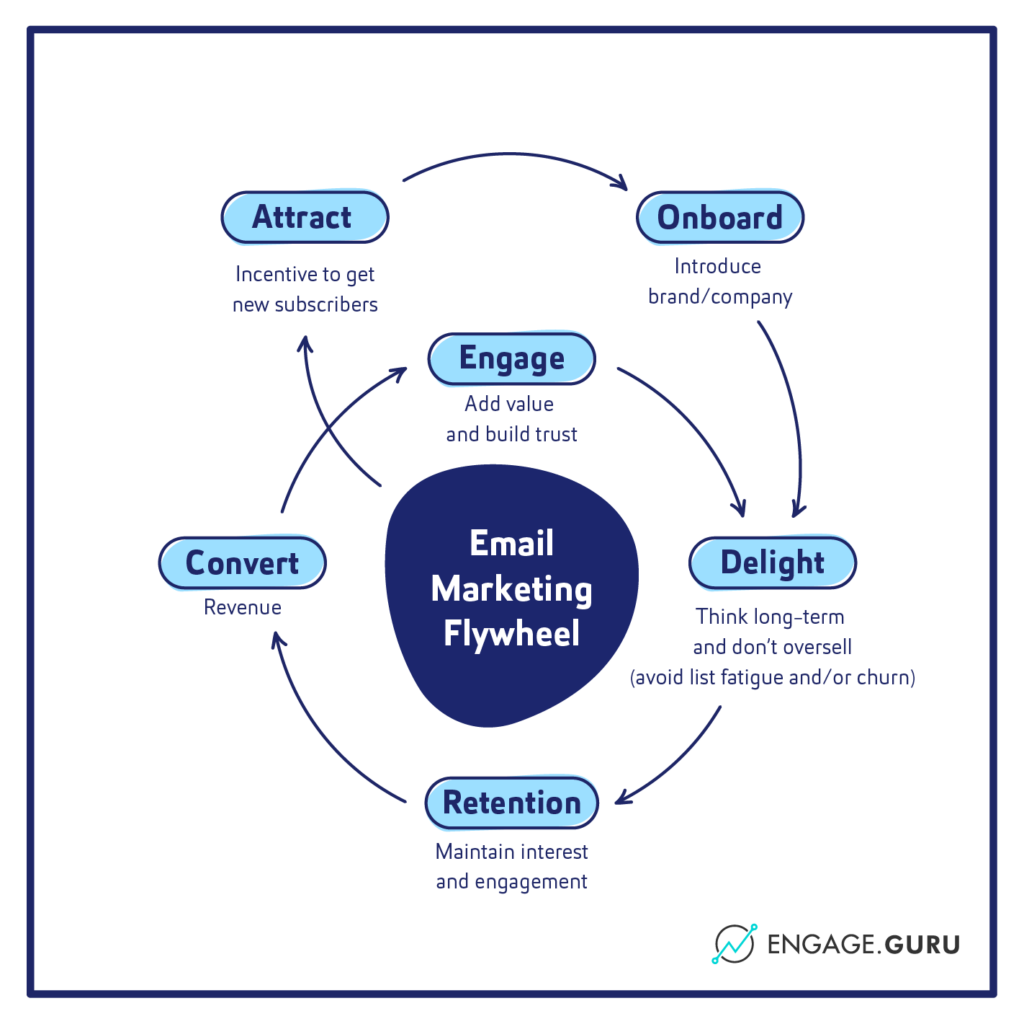
The flywheel has six stages:
Attract
Give people a reason to join your list. An incentive, a useful resource, a loyalty perk. This is where the audience comes from.
Onboard
Introduce your brand properly. New subscribers should learn who you are, what you do, and why it is worth staying subscribed.
Delight
Think long-term and resist the urge to oversell. Every email is a small deposit into (or withdrawal from) the relationship. Overselling causes list fatigue and churn; delighting keeps people reading.
Retention
Maintain interest and engagement over time. Show up regularly with things your audience actually finds relevant, so the relationship does not go cold.
Convert
Revenue. Purchases, bookings, renewals, upgrades. Conversion is a natural byproduct of a healthy relationship, not something you have to force in every message.
Engage
Keep adding value and building trust after the sale. An engaged customer keeps buying, refers others, and often becomes your best source of new subscribers, which spins the wheel again.
The critical point: this is a loop, not a funnel. A customer who converts does not exit the system. They move back into being delighted, retained, and engaged, and they convert again. A subscriber might cycle through these stages many times over years. Each turn of the wheel gets easier, because trust accumulates.
Every step below maps onto this flywheel. If you are ever unsure what to do next with your email program, find the stage that is weakest and strengthen it.
Step 1: Build an Email List You Actually Have Permission to Contact
Everything starts with the list, and there is one non-negotiable rule: only email people who agreed to hear from you.
The mechanics differ by business type:
- Ecommerce: an incentive on the first purchase, such as a discount or free shipping for subscribing.
- Restaurants: a loyalty or birthday program. “Join and get a free dessert on your birthday” fills lists remarkably well.
- Professional services: a truly useful guide, research piece, webinar, or free consultation.
- Local retail: a simple signup at checkout. “Want to hear when new stock arrives?”
- SaaS and product businesses: a newsletter with real educational content, not just release notes.
- Service businesses: helpful content your customers would seek out anyway, like seasonal maintenance checklists.
Whatever the mechanism, the underlying exchange is the same. The subscriber is implicitly asking: “Give me a reason to remain connected to your business.” Your signup offer is your answer.
One detail most businesses skip: set expectations at signup. Tell people what they will receive and roughly how often. “A short weekly email with one useful tip and occasional offers” is a promise. Subscribers who know what they signed up for unsubscribe less and complain almost never.
NOTE: Never buy an email list. Purchased lists can generate complaints, damage sender reputation and deliverability, violate sending-platform policies, and create compliance risk depending on the jurisdiction. Permission-based list growth takes more work, but it creates a much healthier foundation for your email program.
Step 2: Create a Good Welcome Experience
A new subscriber’s attention peaks the moment they sign up. They just expressed interest. They will never be more curious about your business than right now. Yet many small businesses let that moment pass with either silence or a bare “You’re subscribed” confirmation.
A good welcome experience answers five questions:
- Who are you?
- What do you do?
- Why should I care?
- What makes you different?
- What should I do next?
That can be a single well-written email. It does not need to be a seven-part automated sequence with branching logic. A single message that introduces the business, tells a short version of your story, and points to one clear next step already puts you ahead of most competitors.
Start simple. Improve later. If your single welcome email performs well, you can extend it into a short series. If you want inspiration for structure and tone, these welcome email examples show how businesses of very different types handle that first impression.
On the flywheel, this is the Onboard stage, and it sets the tone for everything that follows.
Step 3: Decide on a Consistent Campaign Rhythm
Now the question every small business asks: “What should we send?”
The blank-page problem kills more email programs than any technical issue. So keep a running menu of campaign types and rotate through them:
- Educational content and how-tos related to what you sell
- Product or service recommendations
- Customer stories and case studies
- Your own company story, behind the scenes
- Answers to frequently asked questions
- Announcements and new products or services
- Events
- Offers and promotions (in moderation)
- Seasonal opportunities and gift guides
- Useful reminders (maintenance, renewals, booking windows)
- Practical tips your audience will actually use
- Re-engagement notes to quiet subscribers
- Upsell or cross-sell suggestions where they fit naturally
Notice how few of these are “please buy something.” A program that is 100% promotions trains people to ignore you or leave. A program that mixes value with offers trains people to open.
On frequency: there is no universal magic number, and be suspicious of anyone who sells you one. Weekly works well for many businesses. Twice a month is enough for others. An active ecommerce brand with constant new arrivals can send more. What matters is that the rhythm is sustainable for you and matches what your audience expects. A cadence you can maintain for a year beats an ambitious one you abandon in six weeks.
The tool that makes this manageable is a simple plan of what goes out and when. If you want a structured way to build one, our guide to creating an email marketing calendar walks through it.
Step 4: Stop Treating Every Subscriber the Same
Segmentation has a reputation for being an advanced tactic. It is not. It is just the recognition that a first-time visitor and a five-year customer should not always get identical emails.
Start with distinctions that reflect real differences in your business:
- Prospects vs. customers. People who have never bought need convincing; customers need reasons to return.
- New vs. repeat customers. A first purchase is the start of a relationship; a fifth purchase deserves acknowledgment.
- Active vs. lapsed customers. Someone you have not seen in a year needs a different message than someone who visited last week.
- Product or service interest. The customer who buys running shoes probably cares about different emails than the one who buys yoga gear.
- Purchase behavior. What someone bought before is the best predictor of what they will want next.
- High-value or VIP customers. Your best customers have earned early access, extra attention, or a simple thank-you.
- Location, when it matters: store events, regional offers, local reminders.
You do not need all of these on day one. Two or three meaningful segments capture most of the benefit. The test for any segment is simple: would I actually say something different to this group? If yes, it is a real segment. If no, it is complexity for its own sake, and complexity for its own sake is exactly what this guide is arguing against.
Step 5: Automate the Moments That Should Not Depend on You Remembering
Campaigns are what you send on a schedule. Automations are what fire when a customer does something. For a small business, automation is not about sophistication; it is about removing yourself as the bottleneck for moments that should never be missed.
The most valuable automations map to real customer moments:
- Welcome — a new subscriber joins (see Step 2)
- Post-purchase — thank the customer, confirm details, help them get value from what they bought
- Post-service follow-up — check in after a job, appointment, or project wraps
- Abandoned cart — for ecommerce, a reminder about what was left behind
- Appointment reminders and follow-ups — for anyone who books time
- Replenishment — a reorder nudge when a consumable product is likely running out
- Renewal — ahead of subscription, contract, or membership expirations
- Birthdays and anniversaries — small gestures that build surprising loyalty
- Re-engagement — when a subscriber goes quiet
- Win-back — when a customer has lapsed
Here is the philosophy that keeps automation sane: build an automation because it solves a real customer moment, not because your software has a flow builder. I have audited accounts with fifteen half-finished flows built during a burst of enthusiasm, most doing nothing. One excellent welcome email plus one solid post-purchase follow-up beats all of them.
Start with the two or three moments where a timely email obviously helps your customer. Get those right. Add the rest as real needs appear.
Step 6: Spend More Time Keeping Customers
If your email program only has energy for one strategic priority, make it this one.
Small businesses carry a structural bias toward acquisition. New customers feel like growth; existing customers can feel like a finished job. But your existing customers already know your business and have crossed a trust barrier once. Email gives you an efficient way to keep that relationship active without having to reacquire their attention from scratch.
In most small businesses, the cheapest revenue available is a past customer coming back, and email is the channel built for exactly that.
Retention emails start with better questions. Instead of “what can we promote this week,” ask:
- What would make this customer come back?
- What would help them get more value from what they already bought?
- What else might they need that they do not know we offer?
- What questions do they probably have right now?
- What builds trust between purchases?
- What causes customers to simply forget we exist?
That last question deserves attention. Most customers do not leave angry. They just drift. A competitor’s ad appears at the right moment, or the need comes up and your name does not. Consistent, useful email is the antidote to being forgotten.
Note what retention is not: it is not a synonym for discounting. If every retention email contains a coupon, you are training customers to wait for coupons. Often the highest-value email you can send does not sell at all. It educates, helps, reassures, or reminds. It makes the customer feel that subscribing was a good decision. The sale comes later, and it comes easier.
This is the Delight → Retention → Convert arc of the flywheel in practice. Delight people between transactions, keep the relationship warm, and conversion stops being something you push and starts being something that recurs.
Step 7: Measure What Matters, Then Improve
You do not need a dashboard with forty metrics. You need a handful of signals reviewed on a regular rhythm.
Focus on:
- Clicks — did people care enough to act?
- Conversions — purchases, bookings, leads, replies, whatever action your business runs on
- Unsubscribes — a slow trickle is normal; spikes after specific emails are feedback
- Engagement trends — is your list warming up or cooling down over months?
- Segment behavior — do customers and prospects respond differently, as expected?
- Automation performance — are your welcome and post-purchase flows actually producing action?
- Repeat activity — are subscribers buying again? This is the flywheel’s real scoreboard.
A note on open rates: use them as a rough directional signal, not a precise measurement. Because privacy features can distort open tracking, treat opens as a directional signal. Clicks, conversions, replies and downstream customer behavior generally provide stronger evidence of actual engagement.
More important than any single number: look at trends, not individual campaigns. One email underperforming means little. Three months of declining clicks means something. Review your numbers monthly and ask:
- Which topics generate interest?
- Which offers actually work?
- Which audiences behave differently?
- Which automations produce value, and which just exist?
- Where does engagement fall off?
A healthy email program learns over time. Every send teaches you something about your audience if you are paying attention. That accumulated learning is an asset no competitor can copy.
The New Role of AI in Small-Business Email Marketing
When people hear “AI email marketing,” most picture one thing: a tool that writes email copy. That is real, and useful, but it addresses the smallest part of the problem.
Writing the email was never the hard part. The hard part is everything around it. Someone still has to decide:
- What should we send this week?
- Who should receive it?
- When should it go out?
- Which automations are missing from our program?
- Which customers need attention right now?
- What is actually working?
- What should change next?
For a business with a dedicated email marketer, those questions have an owner. For a typical small business, they have an owner too: you, at 9 p.m., after the actual work of the day is done. That gap between “what a good email program requires” and “what a small business owner has time for” is where email programs quietly die, and it is the problem AI email marketing should actually be solving.
It is also the problem we built Mailberry around. Mailberry is an AI-native email marketing platform powered by The Email Brain™, which learns your business over time: your brand, your products or services, your customers, and the history of your email program itself.
What does that look like in practice?
It helps with the deciding, not just the writing. The Email Brain™ can recognize, for example, that one segment of your audience has gone quiet and should receive a re-engagement campaign, while another segment’s behavior points to an upsell opportunity. Those are exactly the judgment calls that normally require an experienced email marketer reviewing your data.
Automations that keep improving. Mailberry includes SmartFlows, built on a simple observation: automated flows should not be created once and then forgotten. In the real world, that is precisely what happens. A business sets up a welcome flow, and nobody reviews or improves it for months or years while the business, the products, and the audience all change. SmartFlows are designed so the system keeps looking for ways to optimize your flows over time instead of letting them fossilize.
Memory that compounds. The Email Brain™ learns specifically about your brand, your products, your audience, your previous decisions, and how your program has performed. It gets more useful the longer you use it, the same way a great employee does.
None of this removes you from the picture, and it should not. You know your business. The point is to stop requiring you to also be a full-time email strategist.
What Should Small-Business Email Marketing Software Actually Do?
It is worth stepping back and asking what you should expect from email marketing software in the first place, because the answer is changing.
Traditional email platforms give you capabilities: templates, campaign editors, list management, segmentation tools, automation builders, dashboards, and reports. All of that remains useful. But notice what it all has in common. Each capability is a tool waiting for you to operate it. The platform provides the “what’s possible”; you provide the strategy, the decisions, the monitoring, and the labor.
For a business with an email team, that model works. For a small business without one, more tools often just means more work. A powerful automation builder you never have time to open is worth exactly nothing.
The next generation of email platforms should be judged by a different standard: how much do they reduce your operational workload, your decision fatigue, the expertise you are required to have, and the constant manual monitoring your program demands?
That is the philosophy behind Mailberry. The business stays in control; the platform takes on more of the thinking and the operational work. Instead of requiring you to constantly figure out the next step, The Email Brain™ helps identify what to send next, which audiences matter, where opportunities exist, and what can be improved.
You should not need to become an email expert to run an email program worthy of your business.
A Simple Small-Business Email Marketing Plan
Strip away the details and your plan is the flywheel:
Attract. Give people a real reason to join your list, and be upfront about what they will receive.
Onboard. Welcome every new subscriber and introduce your business properly.
Delight. Send useful things, not just promotions. Think long-term.
Retain. Show up consistently so your audience never forgets you.
Convert. Make offers confidently when they are relevant. A trusted sender’s offers get read.
Engage. Keep adding value after the sale, and let happy customers spin the wheel again.
Then repeat, and let it compound.
Do not try to build everything on day one. Start with the highest-value customer moments: a signup offer, a welcome email, one consistent campaign rhythm. Establish consistency before you add sophistication. Watch what your audience responds to, and improve from evidence rather than guesswork.
Email marketing should not become your second job. It should be a system that quietly strengthens every customer relationship you have already earned, week after week, while you run your business.
What if your email platform could help decide what comes next?
Mailberry is an AI-native email marketing platform powered by The Email Brain™. It learns your business, products, and audience to help identify what to send next, build campaigns and flows, and continuously improve your email program over time.

 in Los Angeles